
Can Women Have It All? Have We Been Asking the Wrong Question?

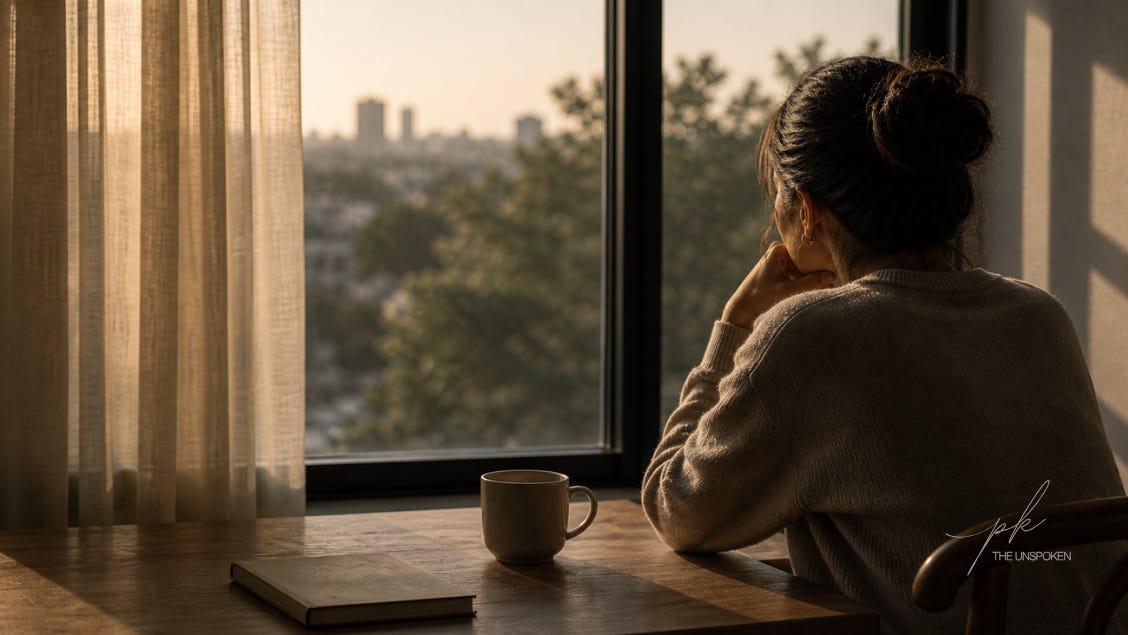
The Unspoken is a series about what's visible and never questioned, and what's invisible and never given a voice.
This is The Unspoken 01
A question came up recently.
Quietly. Almost in passing.
“Can women have it all?”
I’ve heard it before.
But this time it stayed with me. Not because I didn’t have a view. Because something about the question itself didn’t sit right.
So I did what I do when something won’t leave me alone.
I flipped it.
Can men have it all?
And then I looked at the men in my life.
Some are building exactly what they want. Some are managing. And some — more than I had consciously registered — are carrying just as much as the women I know.
Quietly. Without language for it. Without anyone asking.
Which made me wonder why we ever made this a woman’s question at all.
Why Women Are Asking
Women have been vocal about this for a long time now.
Not because the struggle belongs only to them. But because the question got attached to a gender — and stayed there.
Here’s why.
When women began entering spaces never (intentionally) designed for them — boardrooms, leadership roles, careers that demanded singular focus — the tension became visible in a way it never had before.
Because a woman in that room came with an assumption attached.
That her attention will be divided. That home will come first.
And that assumption comes from association.
The school runs. The mental load of remembering everything for everyone. The default parent. The one who notices when the household is holding together — or quietly falling apart.
Not because women chose this.
Because culturally, this was never considered a man’s responsibility.
There are exceptions. But that is what they are. Exceptions.
And then there’s another assumption — that a woman’s ambition and performance drive won’t be the same as a man’s. The opportunities are fewer. The path to the seat is harder.
So when we ask “can women have it all,” what we are really asking is: why does ambition have to look different on a woman?
Now Flip It
Men were handed something at birth too.
Not a question. An identity.
Provider. Breadwinner. The one whose ambition is non-negotiable. Whose focus on work isn’t a choice — it’s what they should do, by default. Whose worth is measured in output, in progression, in never slowing down.
Not having ambition isn’t viewed kindly.
Choosing presence over promotion isn’t in the script.
And so men who feel the pull — toward home, toward stillness, toward something other than forward momentum — make their choices quietly.
And yet saying it out loud risks something they’ve been told their whole lives is foundational.
Their standing. Their identity. What a man is supposed to be for.
So the choice gets made. But never named.
Women agonize out loud — and get judged for the agonizing.
Men decide in silence — and get judged if the silence ever slips.
Neither is free.
The Reality
Sure, the world is moving. Men are making different choices. Women are claiming seats they were never offered. That is progress.
But progress for whom?
Women represent 43% of the global workforce — yet hold just 30% of leadership positions. Only 6% of CEOs globally are women. Just 8% of boards are chaired by a woman. 106 countries have never had a female head of state.
The roles are reversing — but only at the edges. Structurally and culturally, the norm hasn’t moved nearly as much as the conversation suggests.
So yes — the world is changing.
But what percentage of the world’s population is actually living that change?
The Real Challenge
We don’t choose our gender roles.
They are handed to us. Quietly. Thoroughly. From the very beginning.
Through the stories we are told, before we can question them.
Through the expectations that arrive so early, they stop feeling like expectations at all.
They simply feel like the way things are.
But what if we stepped back?
Not politically. Not ideologically.
Just — humanly.
What if we allowed nature rather than culture to shape the choices people make?
What if the woman who wants to build something chose to — fully, without apology?
What if the man who wants to be present at home made that choice openly, without it costing him everything?
We would have more conscious choices. More honest ones. More lives actually lived — rather than performed.
Why The Gap Remains — And Why The Question Still Persists
The consequences are not equal.
When a woman returns to the workforce, slows down, takes a sabbatical, or chooses to be present for her family — the gap follows her.
It becomes the thing people reference. The question in the room nobody quite asks out loud. She has to re-prove herself. Her commitment. Her capability. Her seriousness.
When a man makes the same choice, his identity remains intact. Stepping back doesn’t redefine him. Success still travels with him.
This is not personal. It is structural. The direct consequence of identities assigned at birth and never questioned.
And yet.
Here is the question worth asking —
Where are we complicit in our own diminishment?
Not through weakness. Through habit.
The apologetic qualifier before stating a choice. The over-explanation nobody asked for. The framing of a deliberate decision as something that needs to be justified — to a room, to an employer, to ourselves.
Because if we don’t own the choice, we can’t stand in it. And if we can’t stand in it, we walk back into the room already smaller — before anyone else has said a word.
The structural barrier is real.
The inner work is equally real.
One without the other only gets us halfway.
What I Know
I have made choices consciously throughout my life. And yet — I was never devoid of questioning them.
Moments when health needed more attention. Moments when home came forward. Moments when something else moved to the background because it needed to.
Even making them consciously, there were fears.
How would the gaps be seen? How was I being seen?
I reasoned with myself. I apologized to others. Even when the choice was right.
No one is devoid of the emotions that come with this.
But as I write this piece, something shifted in me.
I don’t have to feel apologetic.
These choices were mine to make. And I made them. They don’t make me less of a person, less of a woman, less of anything.
That is what it actually looks like to have it all.
Not everything at once. But the full range of a life — moved through with intention.
Something will always be in the foreground. Something else will be held quietly behind. And the understanding that what sits in the background is not gone. It’s waiting.
So when women say they can’t have it all — this is where that comes from.
Not weakness. Not failure.
So, “can women have it all” was never the right question.
The right question is, “Can anyone have it all”?
And perhaps even that doesn’t resolve.
Because having it all assumes a full arc. And not everyone gets one.
So maybe it stays open. Hanging. A question we live inside rather than answer.
Can anyone have it all?
I’d like to know where this lands for you.
This piece doesn’t end here. Neither does the conversation. It is the start of a questioning.
Follow me and subscribe to The Unspoken: What’s visible and never questioned. What’s invisible and never given a voice.
P.S. With thanks to Apoorva Deshingkar, whose honest perspective on the man’s side of a story made the thinking sharper.